Xodiac
Software delivery consultancy · Toronto, Canada

You've tried Agile, DevOps and now AI.
Why are customers still waiting?

Each one sped up part of the work. None of them changed the system around it. That's where we start.

Xodiac helps banks, insurers and wealth firms improve how software delivery moves from idea to customer. We identify the value streams that matter, find what constrains them, change the system with your teams, and measure what improved.

AI has changed the economics of software delivery. The operating model we built around yesterday's constraint now needs to be reconsidered. It does not automatically change the reviews, controls, handoffs, platforms and decisions around it. We follow the real value stream end-to-end, establish where you are starting, and improve the part of the system that is actually limiting flow.

Why faster coding hasn't made delivery faster

  1. Your delivery system was built for scarce code.

    Every step was sized around how fast developers could write it.

  2. Then AI made building much faster.

    Code is no longer the scarce part.

  3. Everything around it still moves at the old speed.

    Funding, design reviews, approvals and releases weren't redesigned.

  4. Customers don't get value any sooner.

    Feedback still arrives at human speed.

  5. Speeding up one step only exposes the rest.

    The system was already constrained. AI just made it visible.

  6. Find where your system is really stuck.

    We follow the work end to end, fix the constraints with your teams, and measure what improved.

1/6

20 weeks → 1 week

Average cycle time across the teams we helped at a major Canadian bank.

Source: Xodiac DevOps engagement, average across the teams measured.

Since 2018

A Toronto consultancy working with banks, insurers and wealth firms across North America.

Sound familiar?

The constraint changed. Your delivery system didn't.

Much of modern software delivery was designed when writing code was scarce. Teams, roles and processes evolved to protect developer time and help scarce technical capacity go further. AI is changing that assumption. Making one activity faster does not necessarily make the value stream faster.

You can have Agile teams, DevOps pipelines, dashboards and AI coding tools and still wait weeks for a useful change to reach a customer. The constraint may now sit in review, risk, environments, decision rights, platform access, coordination or somewhere nobody has looked yet.

The feature was finished on a Tuesday. It waited a week for code review. Two more for a risk decision. Another for the next release window. The team built more in the meantime, so the queue got longer. More output entered the system. The customer did not get value any sooner.
The scene is illustrative. It describes a pattern, not a specific client engagement.

What finance asks

“We spend more. What changed?”
Without a useful baseline, activity is easy to show and improvement is hard to prove.

What the delivery leader says

“We build more. We still ship late.”
Accelerating one activity simply moved the constraint elsewhere.

What risk asks

“What are we optimizing for now?”
More throughput through one part of the system can create more pressure on controls, decisions and assurance.

Is this for you?

You lead delivery at a bank, insurer or wealth firm. Your teams have new tools, maybe AI. Leadership is asking whether delivery is actually improving, and the answer is harder than counting code, tickets or tool adoption.

It's not just you

The research shows the same pattern

Google's DORA research calls AI an amplifier: it makes strong delivery systems stronger and struggling ones worse. Faster local activity does not guarantee faster end-to-end flow.

Source: DORA, State of AI-assisted Software Development 2025.

15%

Work waits most of the time.

In teams that don't manage flow, work is actively worked on only about 15% of the time.

Source: Flow Framework benchmark (Mik Kersten, Project to Product).

+91%

Faster building moves the queue.

Teams using AI heavily merged 98% more pull requests, and review time rose 91%.

Source: Faros AI, AI Productivity Paradox Report 2025 (10,000+ developers).

16%

New tools speed up a small slice of the week.

Coding is only about 16% of a developer's time.

Source: Atlassian, State of Developer Experience 2025 (3,500 developers).

10+ hrs

Friction eats the rest.

Half of developers lose more than 10 hours a week finding information, chasing direction and coordinating.

Source: Atlassian, State of Developer Experience 2025.

More code does not automatically mean more value. When one part of the system accelerates, the constraint moves.

Source: Faros AI, AI Productivity Paradox Report 2025 (10,000+ developers).

We've seen this before

They had improved the system. They couldn't prove it.

A major Canadian bank had been running a large DevOps program. Teams had made real changes. Then leadership asked a simple question: what has actually improved?

Nobody could answer confidently because no useful baseline had been established before the work began.

So we started by making the system visible. We created a common way to track work across teams and focused measurement on what would help us decide what to improve next. Then we worked through a series of constraints: deployment friction, team access, environment and resource setup, and other problems surfaced by the teams.

There wasn't one magic fix. There was a sequence: understand the constraint, make an intervention, measure the result, learn, and move to the next one.

Over roughly a year, average cycle time across the teams we measured dropped from 20 weeks to 1 week.

How it works

What changes

1

FromBusy teams

Value that reaches customers

2

From“We can't show the return”

Evidence that supports the next investment decision

3

FromHidden waiting

Visible constraints

4

FromFaster coding

Faster end-to-end delivery

5

From“Standardize everything” or “let every team decide”

Deliberate choices about where consistency creates leverage and where autonomy creates value

Capabilities we bring to the intervention

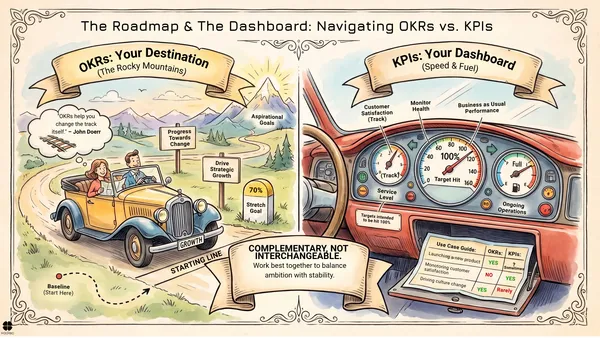
What we change depends on the constraint. That may involve value stream management, DevOps, governance and decision rights, organization design, OKR consulting, agile coaching, platform engineering or operating-model work. These are capabilities we use to improve the system, not separate answers looking for a problem.

For teams already using AI, our focused version of this approach is AI Work Redesign: redesign one workflow around people, AI and controls, then measure what changed.

In their words

From leaders who needed clarity, alignment and measurable improvement across complex delivery systems.

“Eliminate bottlenecks”
Agile coaching, AI-Ops program, major Canadian bank

He excels at aligning our work with broader program goals, ensuring that every task we tackle directly supports our objectives. His guidance on organizing our work has improved our throughput, helping us prioritize effectively and eliminate bottlenecks.

Senior Manager, AI-Ops Program Delivery, major Canadian bank

“Break-glass-in-case-of-emergency”
Senior advisory, Fortune 500 bank

Peter is my break-glass-in-case-of-emergency guy. Able to drop into complex situations and help bring clarity and direction.

VP, Fortune 500 bank

“Where to get started”
Value stream mapping, financial services software

Xodiac conducted a detailed analysis of our delivery practices, looking at DevOps capabilities, and conducting value stream mapping. In a matter of hours, they provided us concrete guidance on how to improve and, most importantly, where to get started. The report they provided added value from delivery teams to C-suite.

Eglys Vera, Head of Technology Delivery & Customer Success North America, Technisys

“We were the ones creating the roadmap”
Delivery roadmap workshop

I was expecting Xodiac to come in, ask a few questions and then make up a report I'd disagree with, like other consultancies I've dealt with. This was entirely different. Throughout the workshop, we were the ones creating the roadmap. I learned more about the end-to-end system than I knew before and, more importantly, about what was on my colleagues' minds! Invaluable experience!

Head of Development

FAQ

Questions we hear first

Xodiac is a Toronto-based software delivery consultancy that helps banks, insurers and wealth firms improve how value moves from idea to customer. We identify the value streams that matter, find what constrains them, make targeted changes with your teams, and measure what improved.

A value stream is the end-to-end path work takes to create a useful outcome for a customer. It crosses teams, decisions, controls and technology, so it rarely matches your org chart or SDLC phases. Plan, code, test and deploy may be activities within a value stream; renaming those phases as value streams does not make the system easier to improve. We diagnose Value Streams with a process called Value Stream Mapping.

Faster coding only improves software delivery if coding is the constraint in the end-to-end system. AI may accelerate development while work still waits for reviews, decisions, environments, controls or release. When one activity gets faster, the constraint often moves.

We mostly work with VPs, heads of delivery and senior directors in financial services: banking, insurance, wealth and capital markets. We also work with software, energy and public sector teams.

Yes, when OKR consulting, agile coaching, leadership, DevOps, value stream management, or governance and decision rights are part of what the value stream needs. They are capabilities we use to change the system, not separate transformations we try to sell regardless of the problem.

We design risk and compliance into the delivery system with the people who own it. We've spent 20+ years inside banks and insurers, and we know that a control that cannot operate at the speed of the system becomes part of the constraint.

Next_Steps // Evaluation_Module

Ready to bridge the
Strategy to Execution gap?

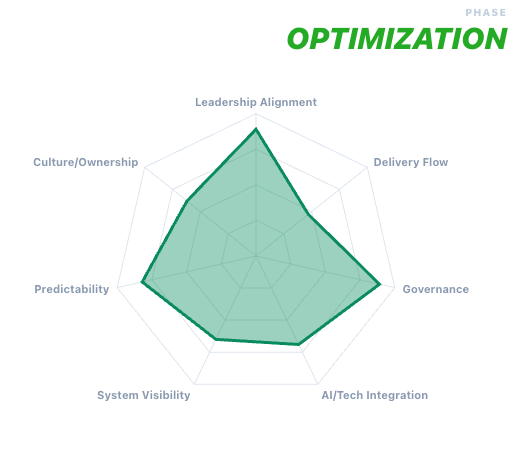
Get a clear 3-step roadmap to evolve your system from Ad-Hoc to Anticipation.

Xodiac Maturity Model Assessment Radar Chart Visualization
Diagnostic // AI_Investment_Analysis

Can you prove your
AI is paying off?

See how well your organization tracks AI spending, adoption and value — and where management attention is needed.

7 minutes. 5 dimensions. One clear picture.